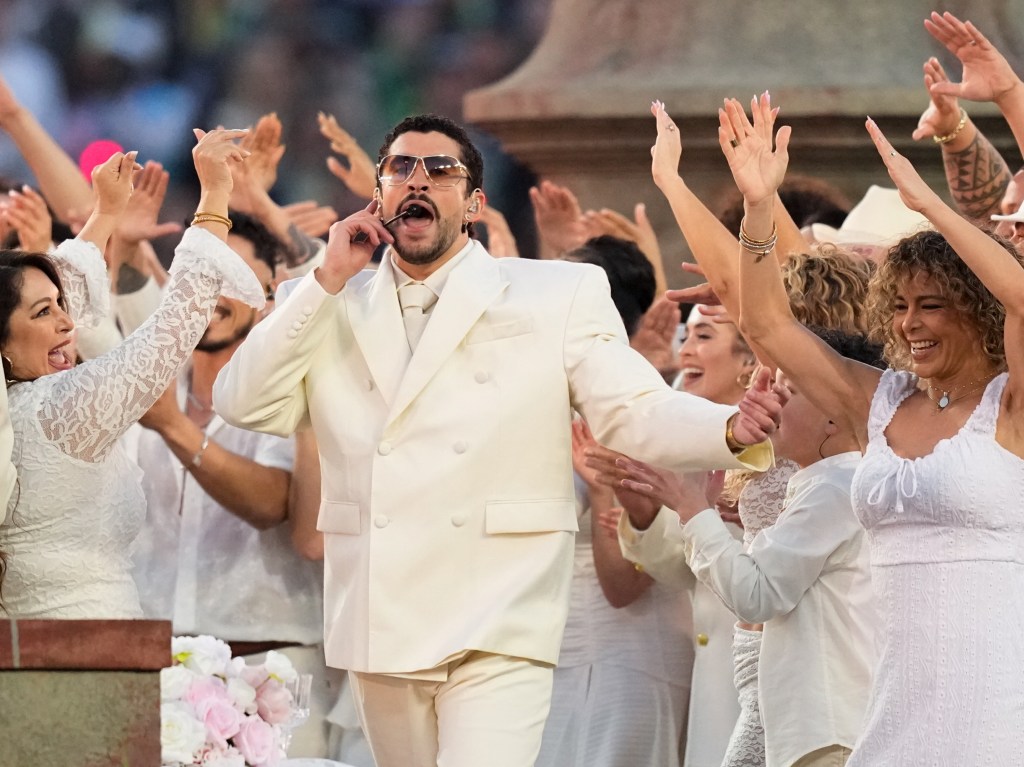
Bad Bunny has been at the top of the music world for a few years now. Especially latelly, between winning Grammys and performing at the Super Bowl, it feels like he’s everywhere. Whether people love or criticize him, they can’t stop talking about him – the spotlight is fixed on him.
Meanwhile, there is a fascinating paradox in his brand. Unlike other global superstars, his storytelling in music videos and live performances doesn’t always revolve around him. He often chooses not to be the protagonist of his own narrative. Instead, he positions himself as a witness, a fan, or a narrator. A genius marketing move, which prioritizes relatability over admiration.
Watching his Super Bowl performance as both a music lover and a marketing researcher, I felt inspired to look closer at these choices. In this post, I want to combine my passion for the music industry with established marketing frameworks to explore how Bad Bunny redefines artist branding and fandom.
The (Anti-)Hero’s Journey
Even as the #1 artist in the world, Bad Bunny maintains the image of the underdog. Marketing research into the “Underdog Effect” suggests that this is a powerful brand position1, particularly when consumers identify with the struggle or when the narrative of the “outsider” is central to their culture. Benito’s path to superstrardom was filled with moments where his refusal to conform should have, by industry standards, held him back.
“English is not my first language. But it’s okay… it’s not America’s first language, either.” Hours before the Super Bowl, Bad Bunny underlined why he remains a defiant anti-hero in an English-centric industry. While he has stated in interviews2 that this isn’t a calculated strategy but a personal conviction, the marketing result is the same: his unconformity has build massive brand equity, even if we just base this on streaming statistics3. This authenticity doesn’t resonate with Spanish speakers only; it attracts anyone who prefers “realness” to a label-engineered reality.
This realness extends beyond his lyrics and into how he visually presents his music. If you watch a Bad Bunny video, you might notice a pleasant deviation from the typical superstar formula: he’s rarely the focus. My favorite example is his video for BAILE INoLVIDABLE, where he joins a salsa dance class. He learns, he makes mistakes, and he experiences the dance as you or I might. There’s also no typical glamour – no luxury cars or designer flexes – which is a huge departure from the usual symbols of the popular latin music scene.
By removing the “superstar filter”, he creates space for the viewer to step into the story. In marketing terms, he’s shifting the Hero’s Journey from the brand to the consumer. Instead of making us watch him be perfect, he invites us to see ourselves in his place. He effectively becomes the “Guide” – a concept introduced by Donald Miller in Building a StoryBrand4 – where the brand exists to help the customer achieve success. In this case, Bad Bunny doesn’t use his platform to demand admiration; he uses it to help his audience see their own cultural identity reflected and celebrated.
From Celebrity to Cultural Platform
One thing in Bad Bunny’s Super Bowl performance that made a very stark impression on me was the diversity of people in the production. While the political and cultural references were of great importance, the most powerful message for me was this of inclusion. In contrast to other memorable Super Bowl performances, the staging wasn’t just the artist and incredibly talented dancers; it featured people of all ages, genders, colors, and life stories.
In artist branding, the artist is the “product”, and every creative choice is designed to enhance that product’s perceived value. However, Bad Bunny’s brand has transitioned into what Douglas Holt calls a “Cultural Icon.”According to Holt’s theory of Cultural Branding5, brands achieve this status by creating “identity myths” – narratives that help people navigate social tensions or express a collective identity that feels overlooked by the mainstream.
Bad Bunny does more than just represent his home of Puerto Rico; he has transformed his fame into a literal and figurative stage for its people. Instead of using a massive marketing opportunity like the Super Bowl halftime show solely to promote his personal image, he used it to validate the identity and struggles of an entire community.
By positioning himself as a platform rather than just a performer, he builds a uniquely resilient form of brand loyalty. His audience doesn’t just admire his success; they feel included in it. In this story, his success is not an individual achievement – it is a shared win for the community he represents.
The music industry is driven by fandom, and just like any other sector, it depends on strong customer engagement and brand loyalty. Because music is an experiential product, it can be difficult to communicate its value trough traditional means. Consequently, the standard strategy since the era of The Beatles has been to build a narrative around the artist as the “Main Character.” This approach creates a sense of distance and awe between the consumer and the product – a phenomenon we rarely observe in other product categories.
For me, watching Bad Bunny’s Super Bowl performance wasn’t just about the music or the message; it was about watching him challenge this industry status quo. He isn’t just breaking barriers by singing in Spanish; he is actively eliminating the distance between his brand and his fans.
Ultimately, Bad Bunny reminds us that the most enduring cultural icons don’t just seek our attention; they give us a sense of belonging. His storytelling lesson to us isn’t to focus on selling the brand, but rather to focus on making your audience feel seen.
References
1 Neeru Paharia, Anat Keinan, Jill Avery, Juliet B. Schor, The Underdog Effect: The Marketing of Disadvantage and Determination through Brand Biography, Journal of Consumer Research, Volume 37, Issue 5, 1 February 2011, Pages 775–790
2 Ruiz, M. (2023, September 12). Bad Bunny on sex, social media, and Kendall Jenner. Vanity Fair. https://www.vanityfair.com/style/2023/09/bad-bunny-on-sex-social-media-and-kendall-jenner
3 Spotify. (2025, December 3). Listeners worldwide crown Bad Bunny Global Top Artist for the fourth time and his latest release takes Global Top Album. Spotify Newsroom. https://newsroom.spotify.com/2025/12/03/bad-bunny-wrapped-2025-global-top-artist/
4 Miller, D. (2025). Building a StoryBrand 2.0: Clarify Your Message So Customers Will Listen. HarperCollins Leadership.
5 Holt, D. B. (2004). How brands become icons: The principles of cultural branding. harvard business press.
 Yana Asenova
Leave a comment